Applied AI Engineer
An Applied AI Engineer builds systems on models that already exist, to solve a real problem for a customer or a product. You do not train models. You build retrieval, agents, and evaluation on top of APIs and open weights, and in most cases you are in front of customers. AI labs and AI product companies hire for it. Some companies post the same role as Forward Deployed Engineer or AI Deployment Engineer.
What the work is
- You decide which problem to solve, with which model and which shape. You pick the high-value problem out of the customer's or the product's set, choose between retrieval, agents, and tool integration, and define what success will be measured on.
- You build the system and take it to production. From prototype through integration, hardening, and launch, writing the code yourself. OpenAI defines success in this role as systems running in production with sustained usage and customer outcomes, and adds explicitly that a successful demo is not the bar.
- You build the evaluation. Model output is not the same twice. Assembling representative data, scoring criteria, and measurement against real production traffic is itself the work. That system is what you tune model behavior, latency, cost, and safety against.
- You solve integration and operations with the customer's engineering team. You connect to their existing systems, data environment, and security requirements, and when something breaks you reproduce it and find the cause.
- You carry the field back to product and research. Patterns that repeat across customers become reusable structure and tooling, so the next deployment moves faster.
How it differs from building models
The letters AI make it read like a model-building role. What you produce, what you are measured on, and what background is expected are all different.
- You use models, you do not build them. OpenAI defines Applied AI Engineering as turning powerful models into reliable, useful systems for people and organizations. Training models belongs to the organization that builds them.
- The bar is different. Model builders are measured on benchmarks. This role is measured on whether the system runs in the customer's environment and keeps getting used.
- The expected background is different. No public posting requires papers or a graduate degree. They look for software engineering and evaluation experience.
How it differs from nearby roles
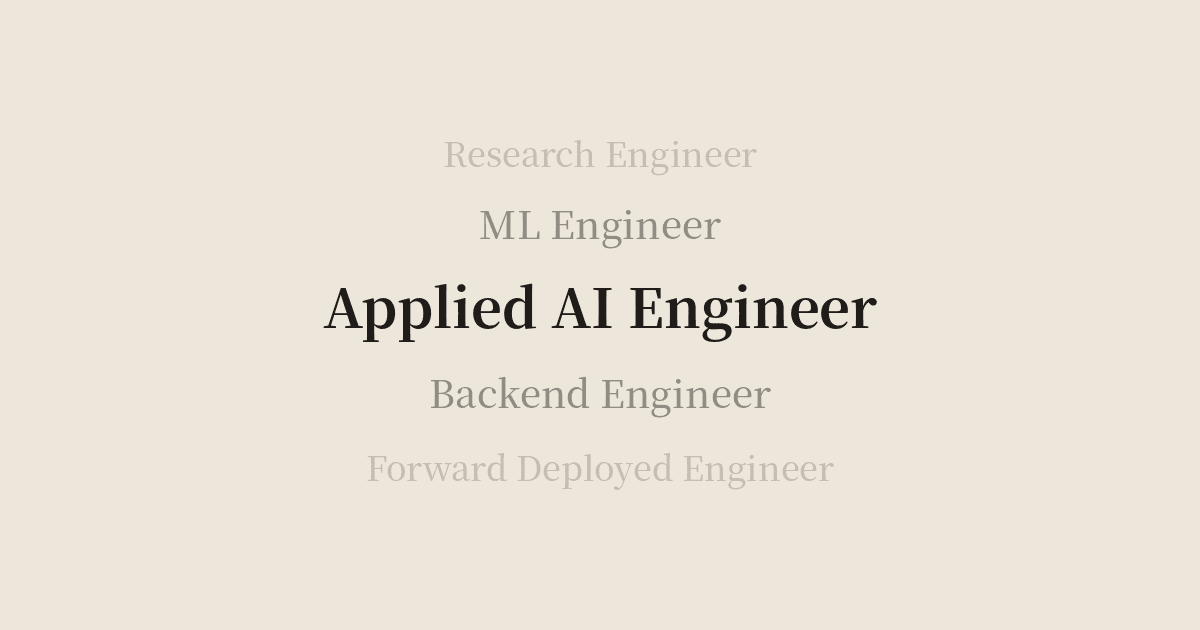
- Machine Learning Engineer: building versus using. A Machine Learning Engineer builds and deploys the models that go into the product. An Applied AI Engineer builds systems on models that already exist.
- Research Engineer: different place in the org. A Research Engineer works inside the organization that builds new models. An Applied AI Engineer works between finished models and the customer.
- Backend Engineer: different material. A Backend Engineer builds systems where the same input gives the same output. An Applied AI Engineer works with probabilistic output, where the same input can give a different result. That is why evaluation sits at the center of the job. Both write code, and postings list software engineers as the expected background.
What companies look for
People arrive from backend and full-stack engineering, Forward Deployed Engineering, and solutions architecture. Korea-based roles require Korean and English. Lay dozens of public Applied AI Engineer postings on top of each other and three things are always there.
- Production-level software engineering. Python is the baseline. TypeScript appears alongside it often.
- Having integrated an LLM into a real system and evaluated it. Retrieval, agents, tool integration, and measuring the result systematically.
- Explaining the technology to both the customer's engineers and their leadership. Most postings assume you are in front of customers.
FAQ
Can a backend engineer move into this? Yes. Postings list software engineers as the expected background, and some state explicitly that LLM experience is not required. The new thing to learn is how to evaluate output that changes every time.
Do you need papers or a graduate degree? No. No public posting lists papers or a graduate degree as required. They look for a bachelor's or equivalent experience.
Are companies hiring Applied AI Engineers in Korea? Yes. It is one of the roles global AI companies open when they enter Korea, and they require Korean and English.